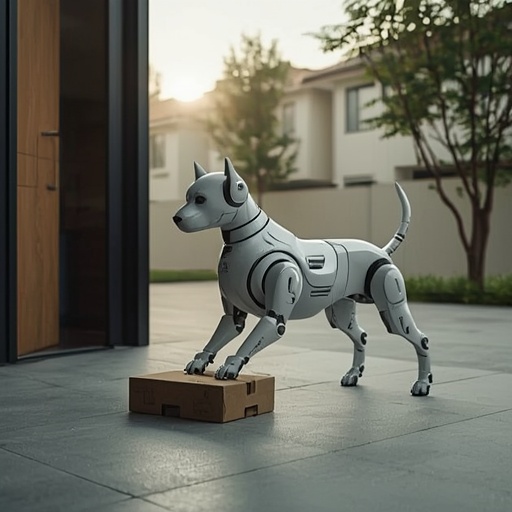
The arrival of robotic ingenuity in the field of logistics is now moving beyond factories and warehouses to the very threshold of our homes. Boston Dynamics has introduced a groundbreaking concept that reimagines the final step in the delivery process — that crucial journey from truck to doorstep — by employing its advanced four-legged automation, the Spot robot dog. These machines, once renowned for their agility in industrial and research environments, are now being tested for one of the most intricate challenges in modern logistics: the ‘last 50 feet’ of delivery.
In traditional delivery systems, that final segment often involves obstacles such as stairs, narrow pathways, uneven surfaces, or even adverse weather conditions, all of which can complicate a driver’s task and affect timing and efficiency. The integration of Boston Dynamics’ robotic companions into this space could signify a major turning point. Imagine a compact, highly intelligent robot navigating a suburban walkway with precision, avoiding garden features, maneuvering around pets or parked bicycles, and gently placing a parcel right at the customer’s doorstep — all without human intervention or delay.
This initiative represents far more than a mere demonstration of engineering excellence; it stands as a potential redefinition of how technology interfaces with consumer logistics. Equipped with sophisticated sensors, adaptive balance systems, and spatial awareness, these robotic dogs can traverse complex terrains that would stall wheels or compromise mobility for traditional machinery. Their mobility grants them an unparalleled advantage in the most unpredictable section of the supply chain, where human delivery personnel typically encounter the greatest inefficiencies.
The implications reach well beyond convenience. By allowing deliveries to proceed autonomously, such innovations promise enhanced safety for drivers, reduced exposure to hazards, and improved time management for delivery companies. In densely populated or hazardous zones, robot dogs could become indispensable, operating efficiently while minimizing error or physical strain. Over time, widespread implementation could lead to significant reductions in operational costs and fuel usage, contributing indirectly to sustainability goals.
As this technology moves from pilot testing to potential real-world deployment, it provokes thought about how we perceive automation within everyday life. Will consumers embrace the sight of a highly mobile robotic courier padding up their driveway, or will the unfamiliar novelty evoke hesitation? Much like the introduction of drones in aerial delivery, public adaptation will hinge on trust, safety assurances, and the reliability of these mechanical canines in performing their duties seamlessly.
In essence, Boston Dynamics’ latest exploration underscores how robotics and artificial intelligence are converging to transform industries once reliant solely on human dexterity and experience. From reducing last-mile inefficiencies to improving both safety and precision, robotic dogs may soon define the next frontier in automated delivery, embodying a fusion of futuristic design, practical innovation, and technological sophistication that brings the future directly to our doors.
Sourse: https://www.businessinsider.com/boston-dynamics-is-using-robot-dog-as-a-delivery-worker-2026-7