Both *Wicked* and its freshly released sequel, *For Good*, are densely sprinkled with what might best be described as distinctive “Oz-isms”—those idiosyncratic turns of phrase and puzzling linguistic inventions that lend the Land of Oz its peculiar charm. Through subtle twists of familiar words, the creators artfully construct a world that feels tantalizingly close to our own while remaining unmistakably fantastical. Words like “obsessulated,” “rejoicify,” and “braverism” shimmer throughout the dialogue, making Oz sound simultaneously whimsical and just a little alien. Yet amid this playful lexical landscape, one particular phrase in *For Good* stands out rather conspicuously, recurring so frequently that it borders on the uncanny: the expression “a clock tick.” Characters repeatedly use it to signify brief intervals of time—assuring one another they’ll return in a clock tick, must wait a clock tick, or have only a clock tick to spare. This obsessive repetition raises a curious question: why does this simple phrase echo through the film with such insistence?
The peculiarity of this linguistic choice becomes even more pronounced when viewed within the film’s already ambiguous treatment of time. *For Good* possesses a sense of temporal vagueness that feels almost deliberate. Even the film’s creators have seemed uncertain, especially in interviews and promotional appearances, about precisely how much time has elapsed since the events of *Wicked*. Within the story itself, Madame Morrible offhandedly remarks that twelve “tide turns” have passed since Elphaba absconded with the Grimmerie—an evocative measure, but one whose actual length remains completely undefined. What exactly constitutes a “tide turn”? Is it a season, a year, or something else entirely unique to Oz? The narrative provides no answer. Similarly, the film’s chronology is murky when audiences attempt to align its events with those of *The Wizard of Oz*, with which it supposedly shares a timeline. As with the original stage musical, the best approach may simply be to stop worrying about temporal consistency altogether and instead embrace its mythic elasticity.
Still, the phrase “a clock tick” refuses to fade into the background; it punctuates *For Good* with disconcerting regularity. Viewers soon notice it cropping up in scene after scene, so insistently that it begins to carry a weight disproportionate to its meaning. This is especially puzzling because we already know that Ozian vernacular includes the more familiar idiom “just a sec.” Glinda herself uses that very phrase at the beginning of *Wicked*, when she momentarily pauses her sparkling bubble to better hear the chattering of the Munchkins below. Given that precedent, “a clock tick” must logically represent roughly the same unit of time—a minute or two at most. Yet it isn’t the semantics that jar the audience; it’s the intensity of repetition. The phrase recurs not only in entirely new scenes crafted for *For Good* but also in moments drawn directly from the stage show, such as the fiery confrontation—half argument, half emotional breakdown—between Elphaba and Glinda. Its deployment there feels like a deliberate stylistic echo of that single instance in the musical, stretched into something emblematic.
By contrast, most of the other Oz-isms scattered throughout *Wicked* and *For Good* are subtle enough to fade into the ether of dialogue, enriching the texture of the world without calling undue attention to themselves. Their effectiveness lies precisely in their unobtrusiveness: they give Oz an aura of linguistic authenticity, implying a shared cultural lexicon without making the audience acutely aware of it. The repeated hammering of “a clock tick,” however, disrupts that delicate balance. There is an additional—and perhaps more intriguing—reason this phrase resonates so oddly. Neither the stage musical nor the film adaptations truly incorporate one of the most thematically potent elements from Gregory Maguire’s original *Wicked* novel: the haunting and mysterious artifact known as the Clock of the Time Dragon.
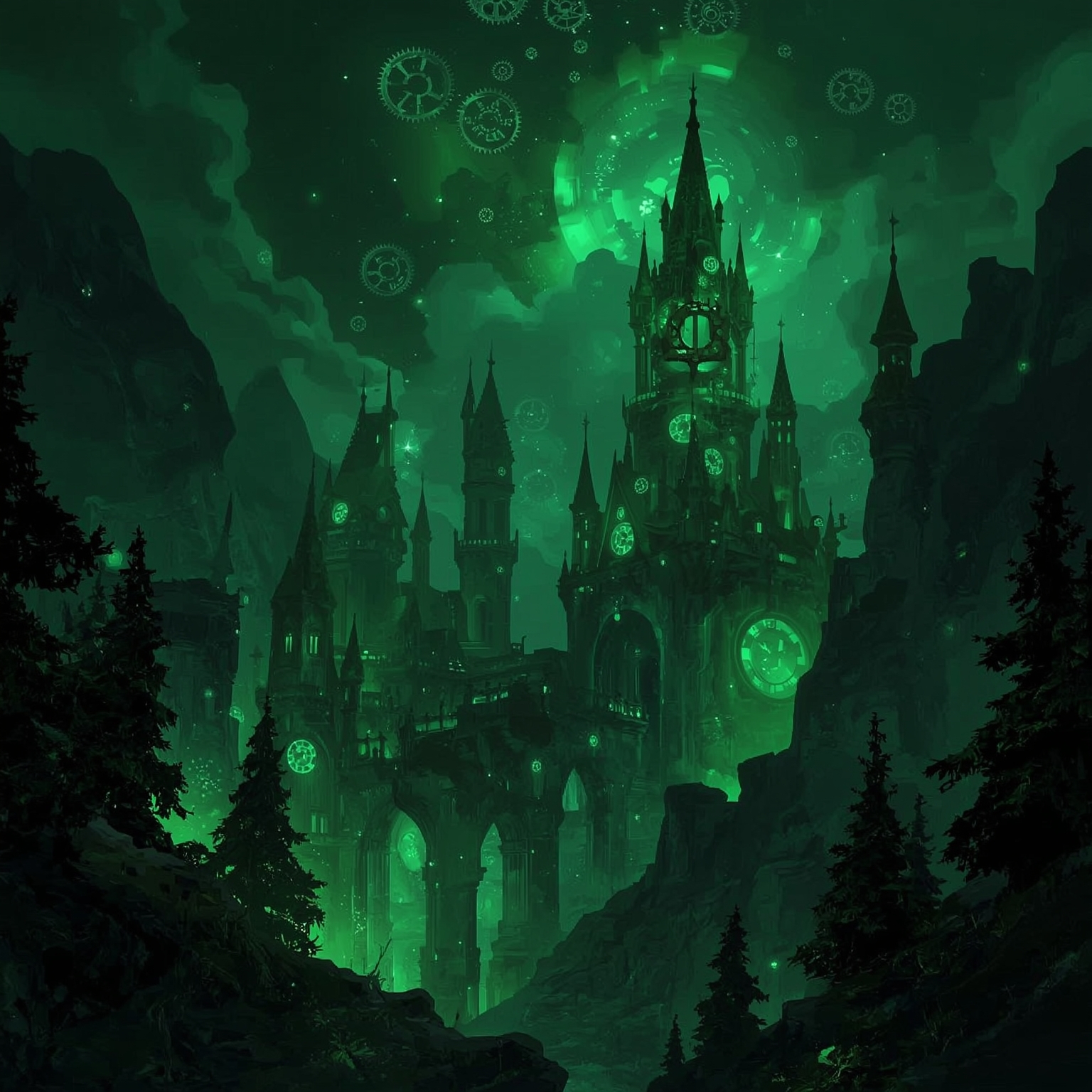
In Maguire’s far darker and more philosophically complex vision of Oz, the Clock of the Time Dragon is no mere prop but a cornerstone of the world’s mythology. It is introduced as an immense, ornate mechanical contraption—a towering automaton shaped like a dragon—that traverses the various provinces of Oz atop a massive wagon. Functioning as both a performance device and a quasi-religious symbol, it stages puppet shows that audiences come to believe possess prophetic power, foretelling the fates of those who watch. For Elphaba, the green-skinned protagonist whose tragic destiny anchors the book, the clock’s significance runs even deeper: she is literally born within its shadow, an origin that fuses her existence with its cosmic, time-bound symbolism. Over the course of the novels, the Time Dragon not only unveils hints about her enigmatic parentage but also seems to prophesy the deaths of several major characters and eventually becomes a secret repository for the Grimmerie itself, the book of spells so coveted in every version of the story.
In contrast, the musical and film interpretations treat this mythic mechanism almost as an afterthought. On stage, the dragon is visually ever-present—an enormous sculpture looming above the proscenium, its iron wings framing the set and its clock face marking the passage of scenes. Yet despite its imposing presence, this feature functions merely as an aesthetic homage to Maguire’s original concept rather than as a meaningful element of the plot. The cinematic versions retreat even further from the idea. In the opening of *Wicked*’s film adaptation, Glinda fleetingly references the clock when recalling the time of Elphaba’s downfall, and attentive viewers might notice the elaborate dragon-shaped timepiece adorning Shiz University’s architecture, a decorative nod to the source material. Beyond these glimpses, however, the Clock of the Time Dragon remains a ghostly absence, stripped of its allegorical and narrative heft.
This omission makes the constant invocation of “a clock tick” in *For Good* all the more enigmatic. Whether intentional or accidental, the repetition feels like an echo of a forgotten mythology, a faint reverberation of the Time Dragon’s presence that once governed ideas of fate, prophecy, and temporal order in Maguire’s original tale. It stands as an inadvertent reminder of how adaptation can both preserve and dilute meaning—how a phrase as simple as “a clock tick” can unwittingly carry the shadow of something vast and mythic. Perhaps that is *For Good*’s most curious achievement: in its relentless ticking, it reawakens our awareness of time’s elusive rhythm in Oz, where every beat of the clock suggests both magic and loss, continuity and erasure.
Sourse: https://gizmodo.com/wicked-for-good-clock-tick-explained-time-dragon-2000691686