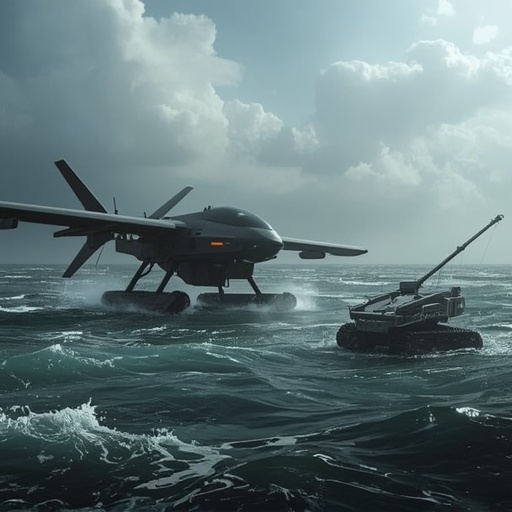
Ukraine has reached an unprecedented landmark in the evolution of contemporary warfare by executing what is widely recognized as the world’s first robotic amphibious assault. In this historic operation, an autonomous drone vessel maneuvered skillfully across turbulent waters to deliver and release a gun-equipped robotic unit onto land, seamlessly merging the domains of marine and terrestrial combat robotics. This event signifies more than just a tactical demonstration—it represents a profound paradigm shift in how nations might wage war in the age of automation.
The fusion of aquatic and ground robotics underscores a sophisticated level of coordination, where machines function in harmony without the immediate presence of human operators. The naval drone, acting as the primary transport and launch system, effectively bridged the gap between sea and shore, enabling the terrestrial robot to operate as an armed forward asset capable of reconnaissance, defense, or direct engagement. Such synergy between autonomous platforms demonstrates how rapidly defense technologies are converging to form integrated systems that can adapt to multifaceted environments.
This innovative feat highlights Ukraine’s growing capacity for cutting-edge technological experimentation within the sphere of autonomous defense systems. By successfully deploying an armed robotic vehicle from an unmanned maritime platform, the nation has not only expanded the functional boundaries of modern robotics but has also hinted at the potential for fully automated joint operations. These advances could lead to revolutionary shifts in military strategy, logistics, and risk management by minimizing human exposure in high-threat missions while maximizing operational precision and efficiency.
Beyond the immediate tactical implications, this achievement demonstrates the accelerating global trend toward the militarization of robotics, artificial intelligence, and remote warfare. As autonomous machines continue to develop enhanced cognitive and navigational abilities, their participation in conflict scenarios may evolve from experimental support roles to dominant operational components. The successful amphibious integration of sea and land systems provides a glimpse into a future battlefield characterized by intelligent, interconnected machines capable of executing complex missions across multiple terrains.
Ultimately, this first-of-its-kind robotic amphibious assault marks a defining step toward a new era of defense innovation—one that blends engineering, artificial intelligence, and strategic autonomy into a cohesive expression of twenty-first-century warfare. It is both a testament to human ingenuity in the field of robotics and a signal that the technological horizon of conflict has once again expanded beyond traditional boundaries.
Sourse: https://www.businessinsider.com/ukraine-launched-robotic-amphibious-assault-mission-2026-7